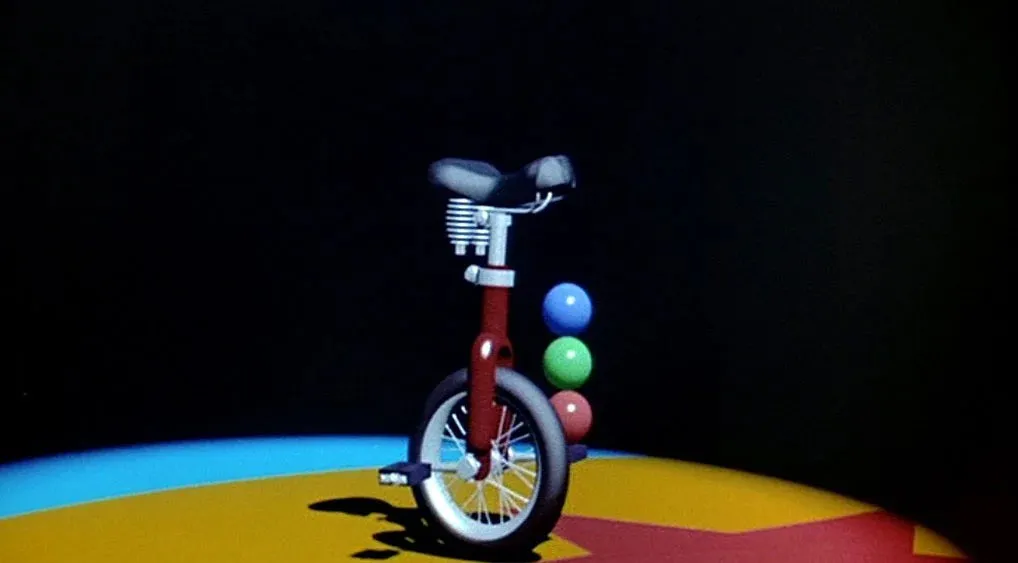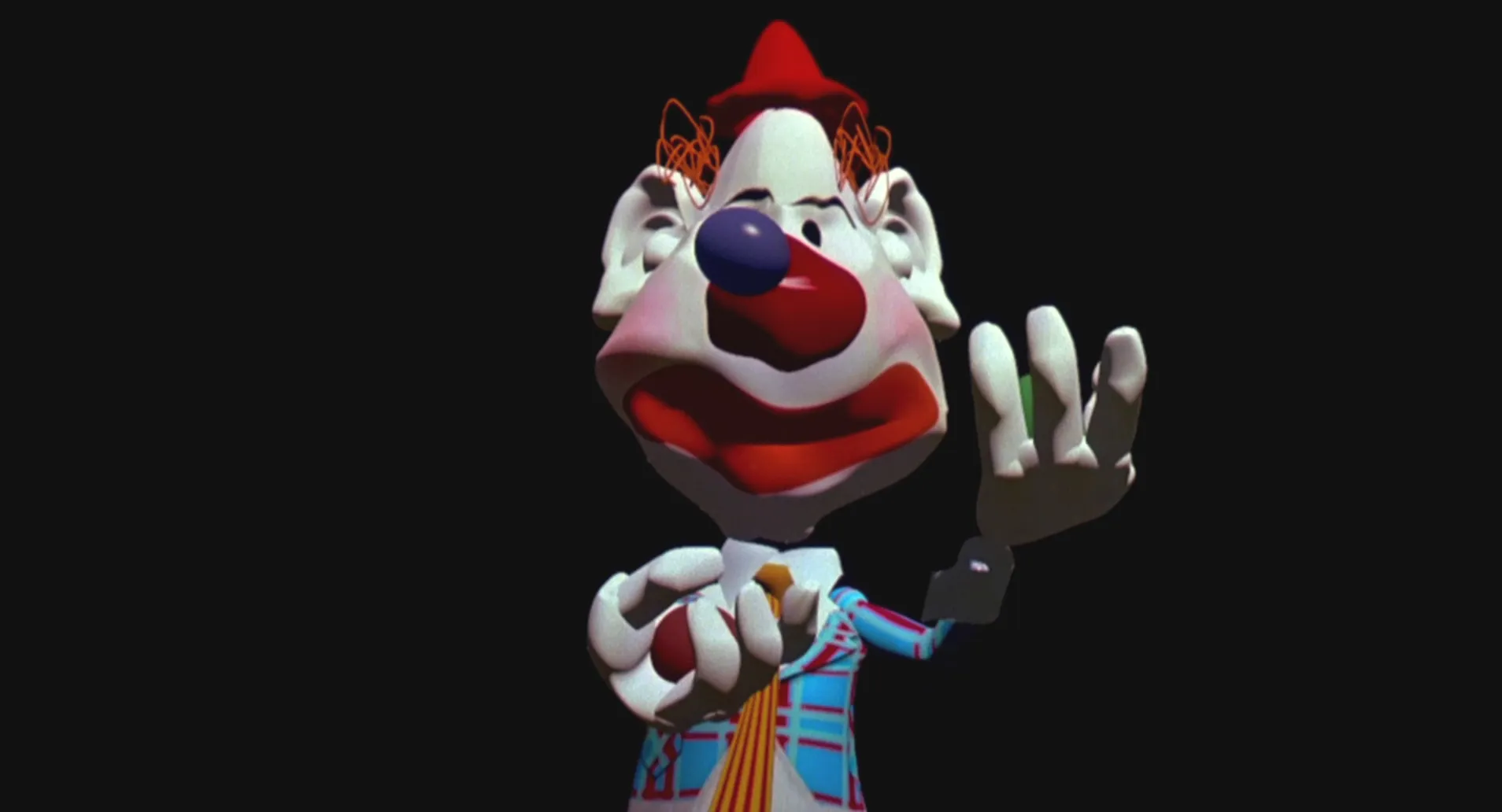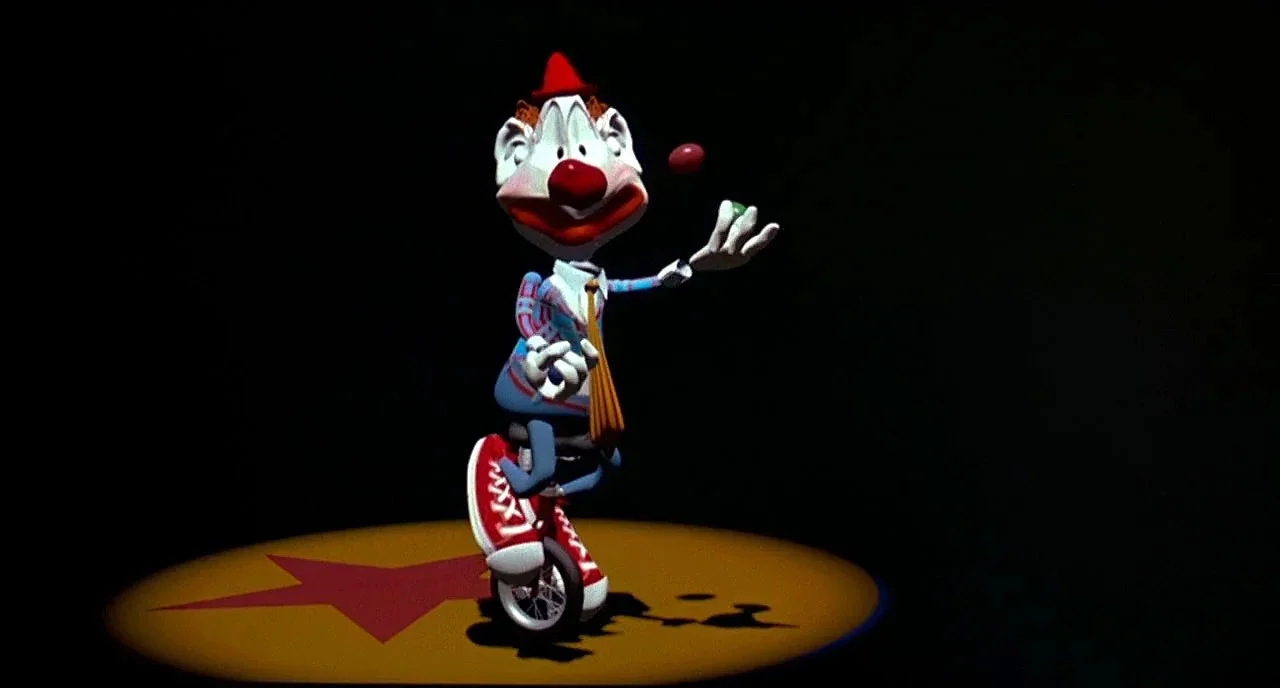
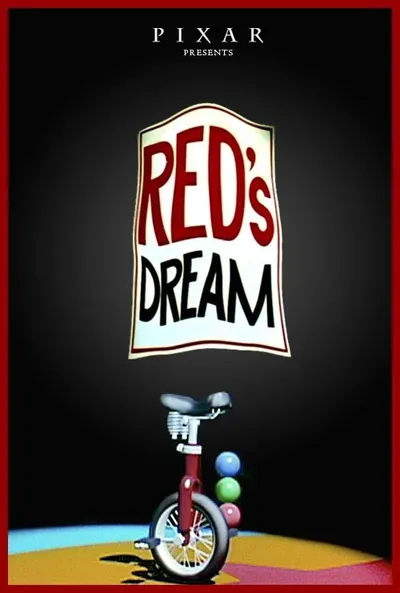
The short film opens in a gloomy and melancholic setting: Red, a bright red unicycle, is sadly abandoned in a dark and damp corner of a bicycle shop. Outside, the sound of pouring rain amplifies the sense of loneliness and stillness. When the shop closes for the night and darkness envelops the space, Red takes refuge in a vivid and sparkling dream. In his dream, the unicycle is no longer a forgotten object, but the star of a great circus show, acclaimed by an enthusiastic audience. The dreamlike scene focuses on the stage: a human juggler enters, attempting to perform his act. However, the performance is a failure: his props fall noisily to the ground. This is where Red springs into life and action: he moves nimbly across the ring, picks up the fallen pins and, with astonishing dexterity, begins to juggle flawlessly as he moves. Red steals the show, performing a spectacular act that immediately puts him in the spotlight, becoming the true star of the show. The dream reaches its climax with a wave of thunderous applause and the crowd's ovation. The noise, however, is too intense and the dream ends abruptly. Red wakes up with a start, finding himself alone again in the oppressive darkness of the shop. Reality collides with illusion: the unicycle bitterly realises that his life as an acclaimed star was just a sweet but fleeting night-time fantasy.
In Red's Dream, the complex juggling sequence involving Red's unicycle required an advanced mathematical solution to ensure credible movements and interactions between objects. To animate the throwing, falling and catching of the pins (represented here by balls), the animators relied on a sophisticated quadratic programming algorithm. This algorithm was specifically designed to automatically calculate the parabolic trajectories of the balls. Instead of having to manually draw each frame of the complex movement, the system took a few key points (such as the launch point and the reception point) as input and generated the entire flight curve accurately and physically. This ensured extreme accuracy and fluidity in the juggling act, which would otherwise have been extremely laborious to animate. The rendering software used at the time, particularly PIC (Pixar Image Computer), had a significant limitation: it did not support the Motion Blur effect, which is essential for simulating the speed and visual realism of fast-moving objects (as seen in André and Wally B.). To compensate for the absence of motion blur and maintain the illusion of fast, dynamic movement, an additional crucial feature was added to the aforementioned quadratic programming algorithm: - Squash & stretch deformation: the algorithm was tasked with automatically calculating and applying the deformation (squash & stretch) of the balls during bounces. - Squash: upon impact with the ground or Red, the ball would squash for a single frame, simulating kinetic force. - Stretch: between points in the throw, the ball would stretch slightly along its trajectory to exaggerate the perception of speed. This technique, taken directly from the fundamental principles of traditional animation, made the movement of the balls more realistic, impactful and visually dynamic, effectively compensating for the lack of digital motion blur.
In those years, Pixar used the REYES (‘Render Everything You Ever Saw’) rendering architecture, whose key concept was that all complex geometries were divided into ‘micropolygons’, on which shading and visibility operations were then performed. This approach made it possible to handle very complex scenes with many objects, because it “normalised” the complexity of the geometry to a very fine level, making it a technique well suited to high-quality rendering. The director of the Red's Dream project, Ed Catmull, wanted the short film to be made using their hardware system, the Pixar Image Computer (PIC), and the ChapReyes rendering software (based on REYES). The Pixar Image Computer was a very advanced graphics system for its time, designed for parallel processing, with high memory bandwidth and bus speed. Although powerful, it had critical memory limitations for ChapReyes, so it was reduced to only a limited number of features. Due to these limitations, only the dream sequence was actually produced entirely with PIC. The bicycle shop scenes were extremely complex: a typical frame of those scenes contained over 10,000 geometric primitives, which in turn were composed of more than 30 million polygons. Nonostante il sistema PIC fosse potente, dopo la produzione di Red’s Dream, fu deciso di abbandonare questa tecnologia a causa delle sue limitazioni. The advantage of ChapReyes was that it could process between 50,000 and 100,000 complex polygons per minute, thereby significantly reducing the rendering time for frames that included textured surfaces, texture maps, multiple light sources, and shadows.