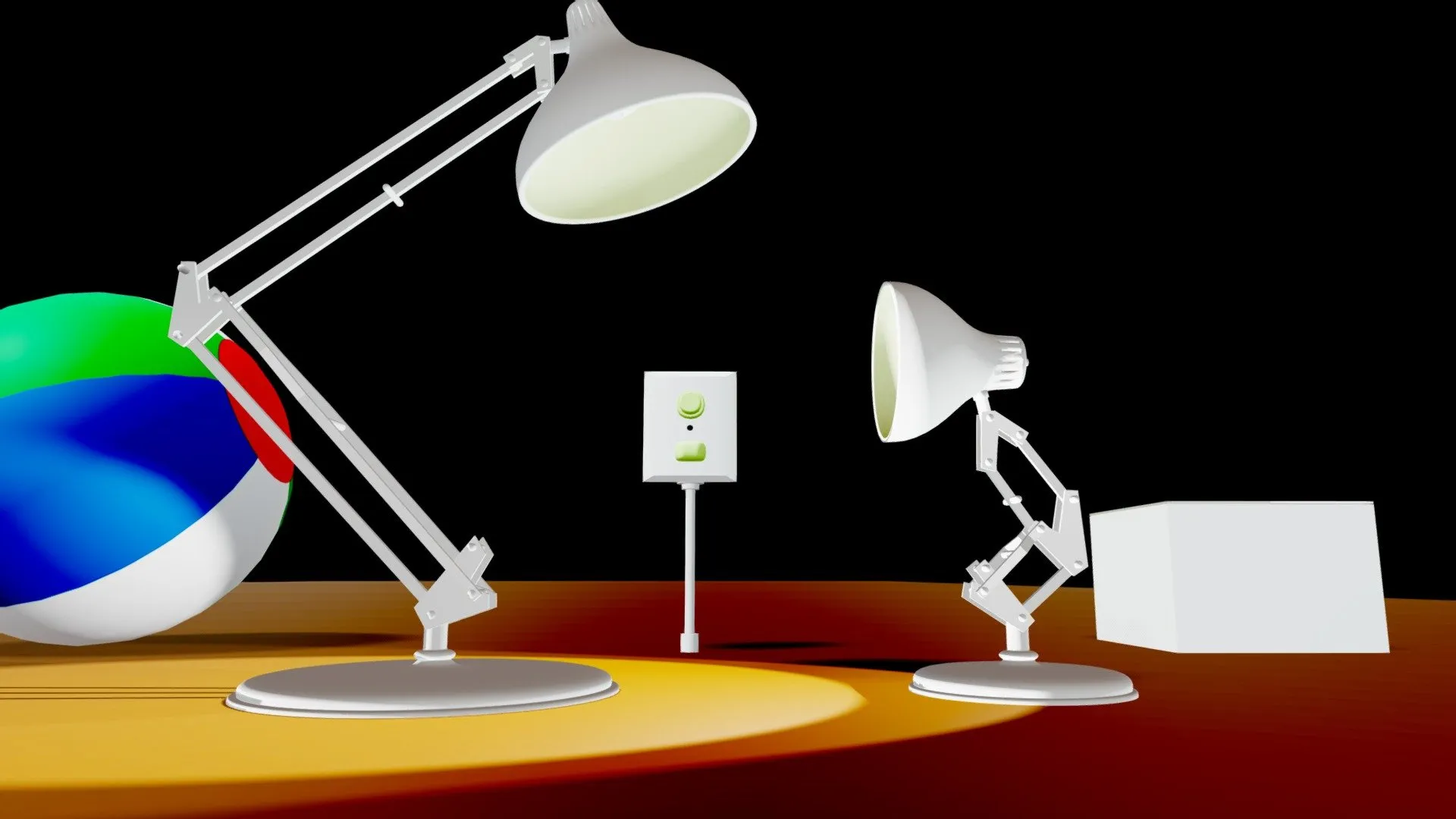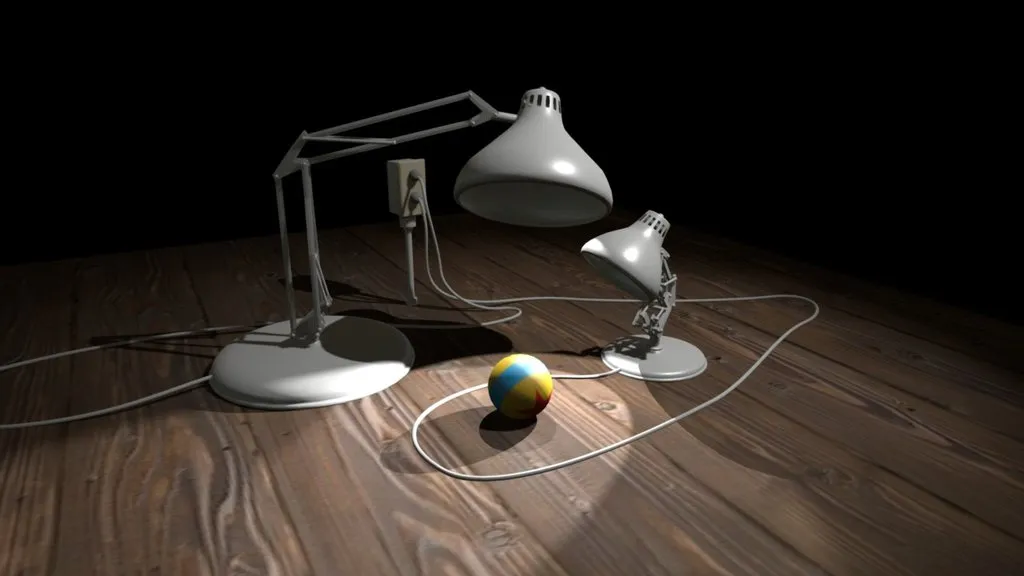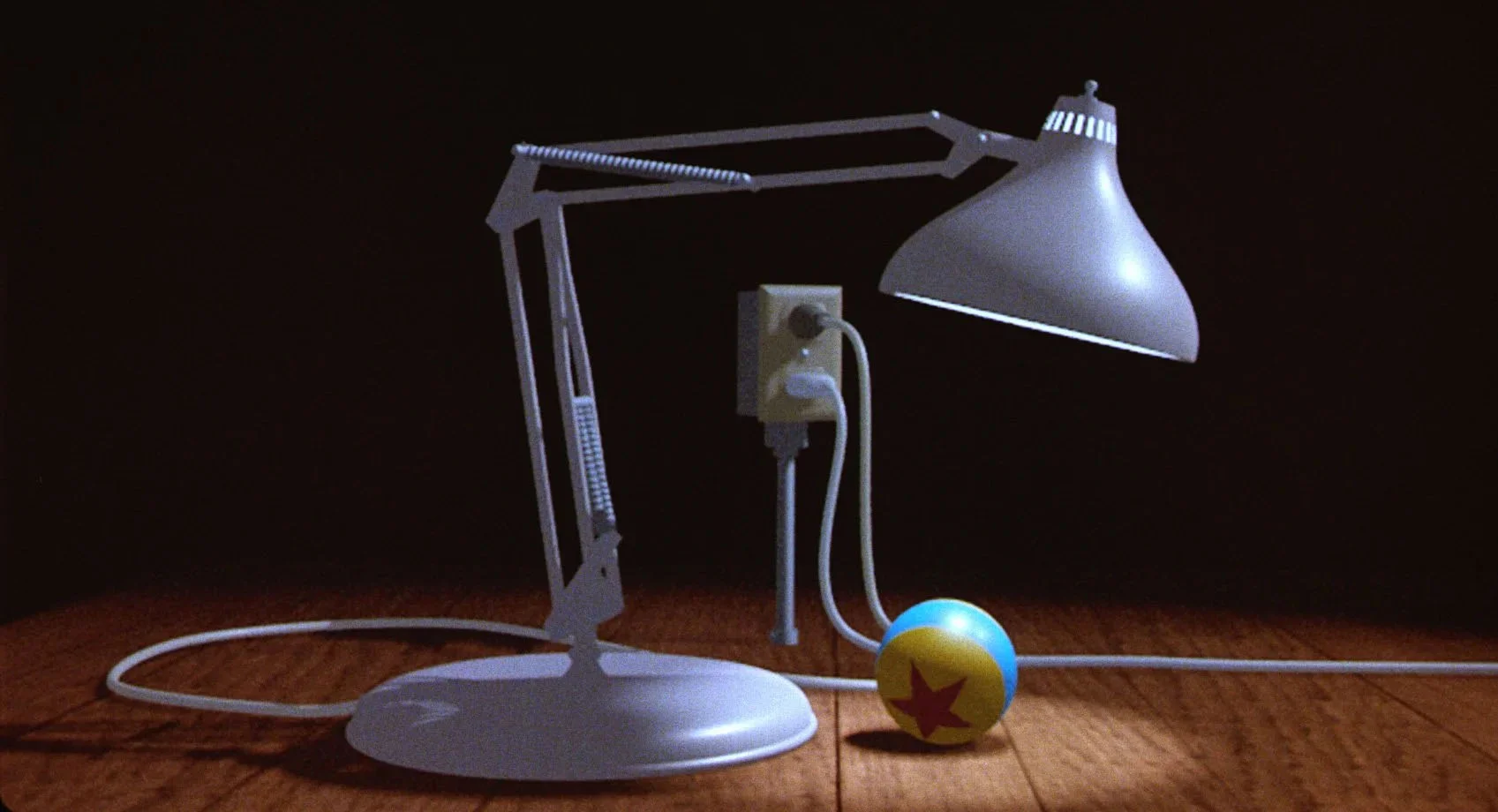
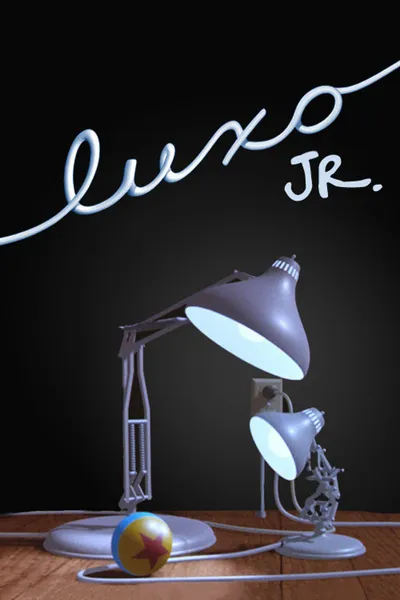
The action takes place in a minimalist, dimly lit setting dominated by a large desk. Here, the protagonist, Luxo, the larger table lamp, sits still and motionless. His tranquillity is interrupted when a small yellow and blue ball rolls silently into his field of vision. Luxo, intrigued and perhaps a little annoyed, looks closely at the object and, with a decisive movement of his bulbous head, pushes it away. However, with a stubbornness typical of toys, the ball immediately rolls back. Luxo pushes it away again, but this time the ball stops to one side, just as Luxo Junior, his lively little son, suddenly jumps onto the scene. Little Luxo Junior, full of energy, begins to play enthusiastically and impetuously with the ball, jumping around it and pushing it with his “head”. In a moment of childish exuberance, Luxo Junior takes a leap and clumsily balances himself on top of the ball. The weight and movement inevitably crush him, and the ball deflates completely with a silent sigh. The little lamp, realising his mistake, moves the flattened ball and looks shyly at his father, Luxo. His father responds with a shake of his head that is a mixture of disappointment and affectionate reproach. Feeling guilty, Luxo Junior clumsily leaves the scene. Shortly afterwards, however, his playful nature reasserts itself: Luxo Junior cheerfully reappears on the scene, jumping and playing with a much larger beach ball, as if nothing had happened. Luxo, his father, observes his son's irrepressible cheerfulness, turns to the camera and shakes his head, with an expression that conveys sincere and affectionate paternal embarrassment.
In Luxo Jr., self-shadowing was not simply an aesthetic addition, but a fundamental revolution in the perception of realism and physicality in 3D models. Before this technique, computer-generated objects often appeared "flat" or "floating", lacking weight and substance, as light hit them uniformly without different parts of an object casting shadows on it. The Pixar team implemented advanced rendering algorithms, probably based on a form of ray tracing or sophisticated shadow mapping techniques, to allow objects to cast shadows on themselves. Credible physicality: this technique had a crucial impact on the physical credibility of Luxo Sr. and Luxo Jr. You could clearly see the shadows cast by the lampshade on the arm, or those of the articulated joints on the base or lower segments. Perception of mass and Volume: the presence of self-cast shadows immediately transformed the simple geometric models (whose shapes were already complex) from mere polygonal constructions into tangible objects with perceived mass and volume. The shadow defined their three-dimensional shape and position in space, making them appear heavy and real. Characterisation: shading helped to breathe life into the characters. Light and shadow emphasised the movements of the “head” and “body”, transforming simple lamps into real “actors” with a defined stage presence, which was crucial to the narrative. In summary, self-shadowing in Luxo Jr. was a key element in overcoming the "syntheticity" of early computer graphics, making the characters solid, realistic and deeply expressive.
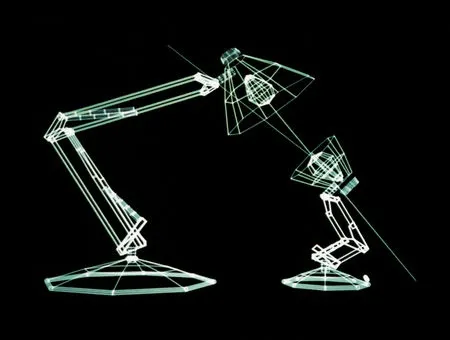
Luxo Jr. was a seminal short film for procedural animation. The surfaces in the short were not textured using bitmap images; colouring and light response were handled using surface shaders (programmed in the style that would later become standard with RenderMan). Colour, reflection and response to lighting were calculated procedurally at render time. John Lasseter animated the key poses and “character” behaviour of the lamps; Eben Ostby created procedural routines for repetitive tasks — for example, rolling the ball along its drawn trajectory and making it behave realistically. Luxo Jr. was an early practical example of “animator + computer”: the animator retains creative control over the keyframes, while the software automates the physical and repetitive details.