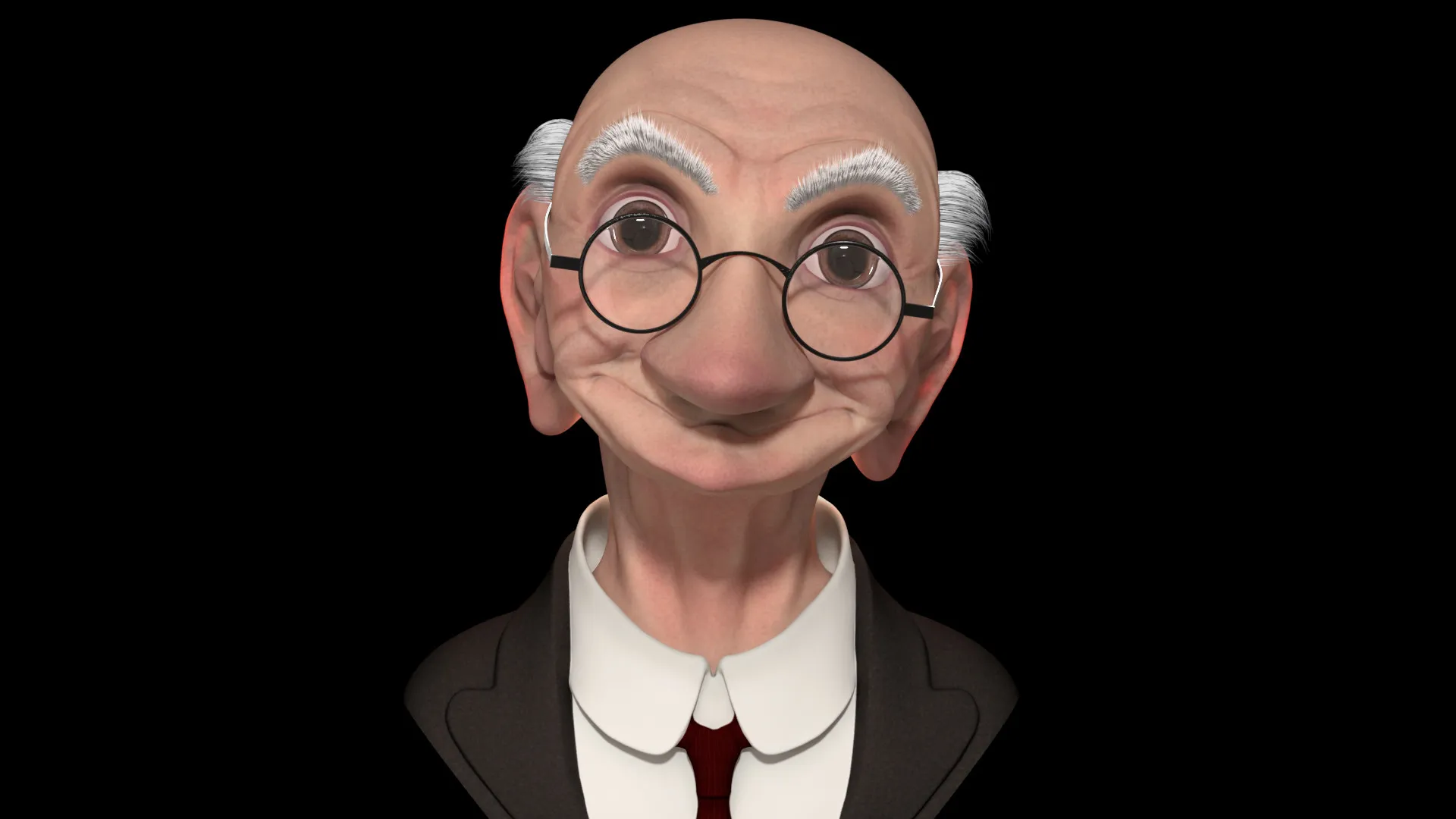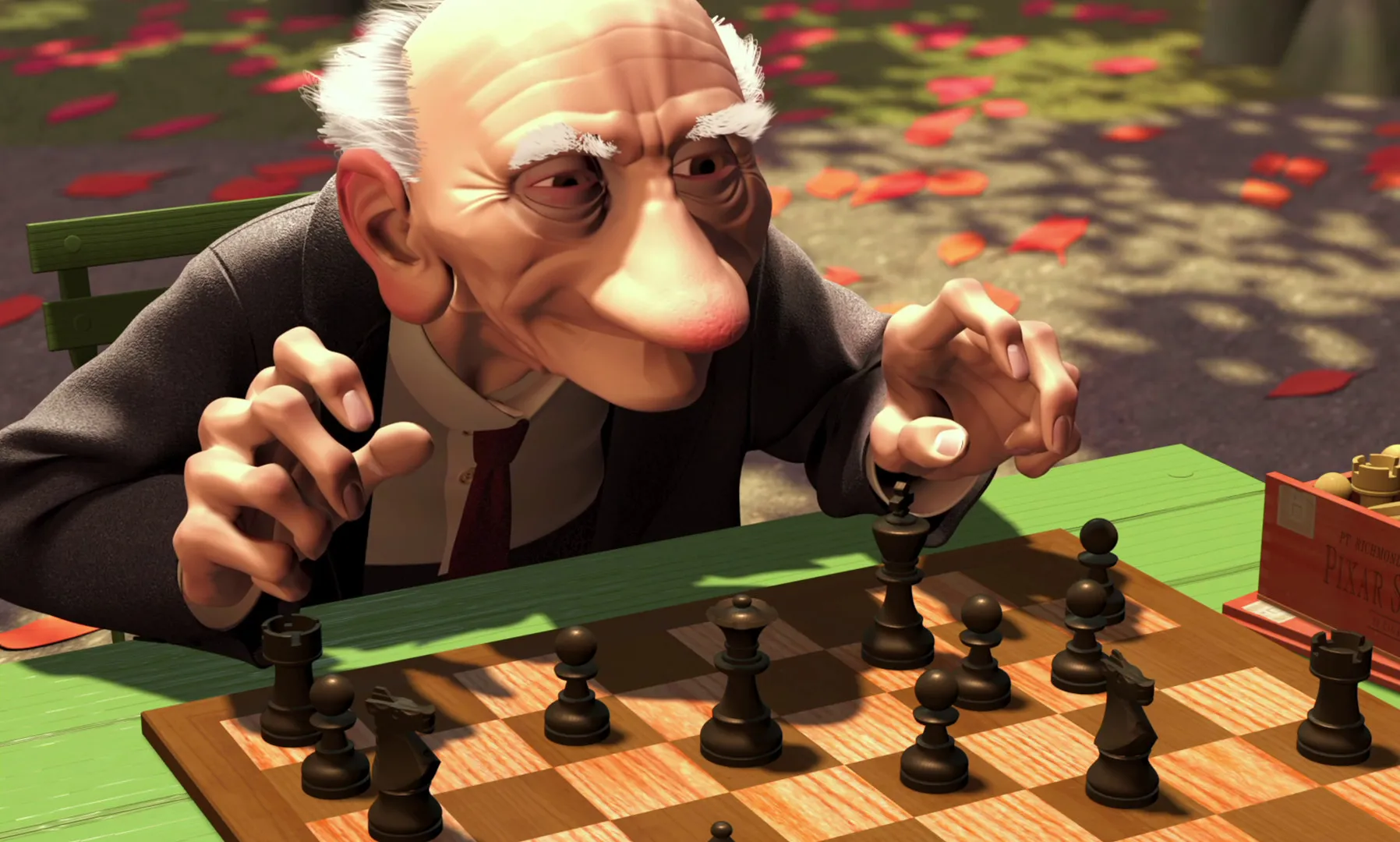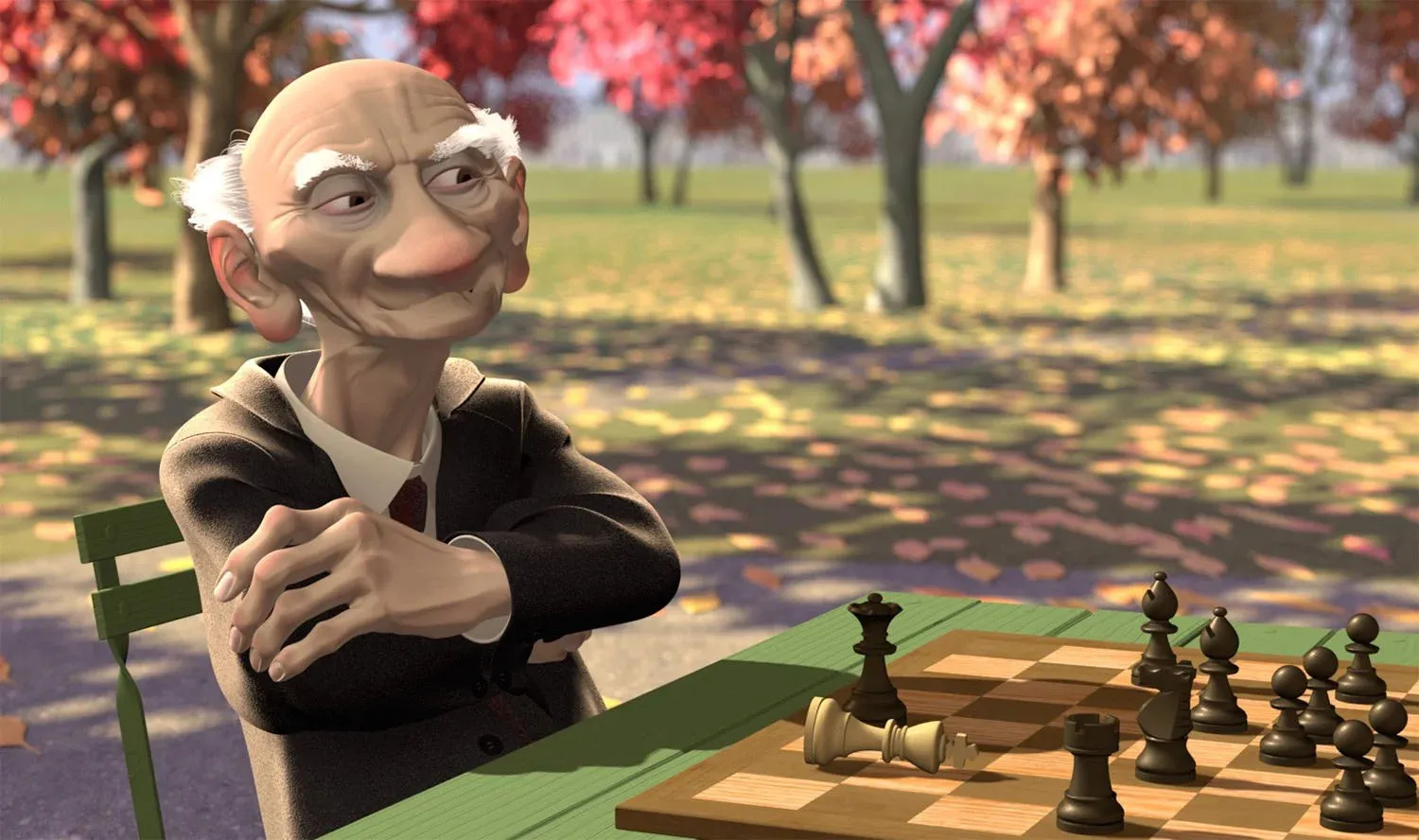

An elderly curmudgeon named Geri spends an entire day in the park playing a game of chess against himself. At a certain point, he begins to lose against his livelier opponent. But just when the match is about to end, Geri manages to turn the situation around.
In Geri’s Game, Pixar aimed to create a human character with a level of anatomical and emotional realism that had not been achieved before in computer animation. Unlike previous characters, Geri required detailed facial expressions, subtle deformations of the skin, and natural articulation of hands and joints, all of which are particularly challenging when using traditional polygonal modeling techniques. Low-resolution meshes tended to produce rigid, angular results, while manually modeling high-resolution geometry was impractical and difficult to animate. To overcome these limitations, Pixar adopted subdivision surface modeling, a technique capable of generating smooth, organic forms from simple base meshes, making it possible to represent the complexity of an aging human face while maintaining an efficient and controllable animation workflow.
Subdivision surfaces are based on the use of a low-resolution polygonal control cage that defines the overall shape of a model. Through an iterative mathematical process—most commonly relying on the Catmull–Clark subdivision algorithm—the mesh is repeatedly subdivided, generating new vertices and smaller polygons at each step. These vertices are repositioned according to weighted averaging rules that smooth the surface and gradually eliminate sharp angles, producing a continuous, curved form. In Geri’s Game, animators manipulated the coarse control mesh to define expressions and movements, while the subdivision process automatically generated the detailed surface at render time. This approach allowed Pixar to separate animation control from geometric complexity, enabling highly detailed facial and hand deformations without increasing the burden on modeling or animation, and making realistic human characters feasible within a production pipeline.